
Part One
Who Really Owns DC Turnover? (Hint: It’s Not HR)… Each exit affects continuity of coverage, reduces throughput, undermines productivity, reduces cross-training opportunities, adds unnecessary burdens to the remaining associates, etc. The problem extends beyond filling an open position or the cost of hiring a replacement. Turnover disrupts training continuity, reduces consistency of processes, encourages absenteeism and morale issues, disrupts the stability of operations on the floor every day, etc. Retention must be treated as an operations-level problem because of its direct impact on throughput, service, and reliability of labor.
This article will propose that with better visibility of costs and practical systems to improve continuity of coverage, operations has the greatest chance to improve retention and performance on the floor. Examples include the impact of training continuity, microlearning, availability of documentation, availability of incentives, and cross-functional communications.
Impact of High Turnover on Distribution Centers
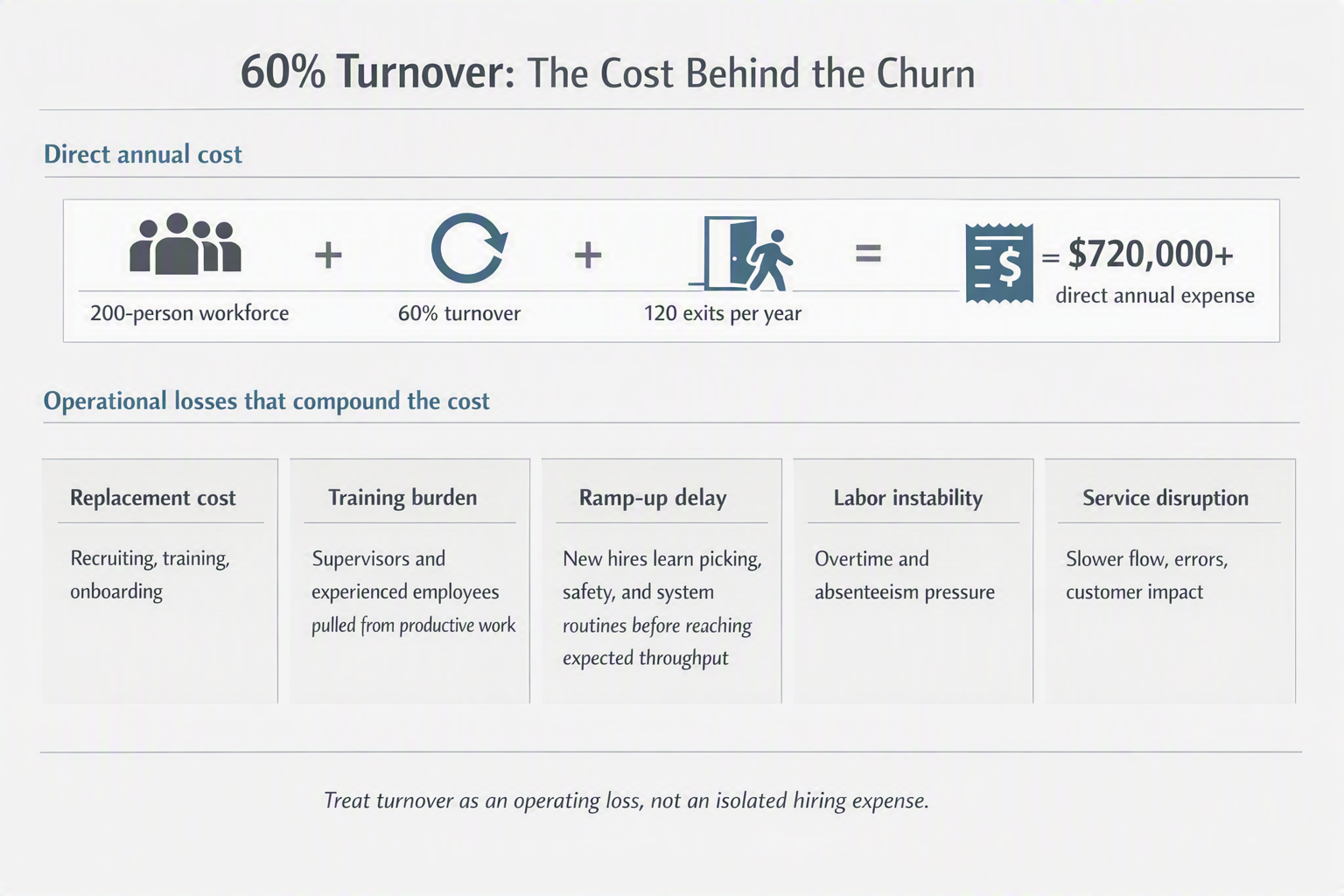
A 60% turnover rate imposes direct and recurring operating costs on a distribution center. In a 200-member workforce, that level of churn means 120 exits in a year and, at more than $6,000 in recruiting, training, and onboarding cost per exit, at least $720,000 in direct annual expense. Recruitment expense is only the first pressure. Training delay removes experienced employees and supervisors from productive work so new hires can learn picking methods, safety requirements, and system routines before reaching expected throughput. Research on warehouse labor practices links turnover to replacement cost, training burden, overtime, absenteeism, and customer service disruption, which is why these expenses should be treated as operational losses rather than isolated hiring costs (Min, 2004). As vacancies and onboarding cycles continue, planning becomes less reliable and managers must spend more time correcting flow problems instead of sustaining performance.
Absenteeism has a multiplying negative effect. When the production schedule becomes less stable and the workload unexpected, the burden shifts on to the other employees unable to maintain their attendance or morale in the face of increased errors, missing paperwork, and retraining. The overall effect cascades into lower productivity, less reliable and efficient operations across receiving, picking, packing and replenishing, and prolonged resolution times during normal peaks and excessive demand. High turnover impacts delivery reliability not just through headcount, but through the shared rhythm and confidence that sustain operational delivery from a distribution center.
We know the exact utilization rate of every truck, scanner, and square foot of rack space in the building.
Yet, we treat the loss of our most critical operational asset, the people running them, as an unavoidable cost of doing business. HR owns the onboarding paperwork, but operations owns the floor environment that makes people stay or walk out.
It is time to stop treating turnover like a hiring pipeline issue and start treating it like the operational process failure it actually is.
Transition of Retention Ownership from HR to Operations
Operations should own retention because it controls the daily conditions that most directly shape whether employees remain in the job, including the pace of onboarding, access to documentation and tools, workload balance, schedule consistency, supervisor coaching, and the fair execution of incentives. These are not peripheral issues but operating conditions managed on each shift, and assigning retention to Operations aligns responsibility for turnover with responsibility for output, quality, and attendance. This ownership shift also makes core metrics such as recruitment expense, training lag, and absenteeism actionable management signals rather than downstream HR reports, since turnover raises replacement and overtime costs, extends the time required for new employees to reach productivity, and disrupts service performance and logistics continuity (Min, 2004). At the same time, HR remains a necessary partner rather than the primary owner, with responsibility for hiring policy, manager development, and data sharing that support consistent decision-making across the organization. In this model, Operations owns the daily practices that sustain retention, while HR provides the governance and capability support needed to keep those practices effective and aligned.
Operations Led Retention Strategies
Retention systems aligned with Operations should begin with rethinking how employees learn, do, and are supported on each shift. Delivering relevant, task-specific microlearning at the point of work can shorten the time employees are away from their workstations for training and allow them to apply the information on-the-job rather than waiting for a formal training opportunity. Access to current, usable process documentation that accurately reflects standard work can support basic learning and provide workers with a go-to resource when the work changes or they are unsure of how to proceed. Retention must consider the daily realities of work, including pacing, support, and appropriate recognition of successful outcomes – operational systems that place additional burden on workers without consideration for coordination can amplify dissatisfaction. Many younger workers may prefer short “bursts” of information, easy access to procedure documents, and more regular feedback – however, these characteristics should not be considered generational norms, but rather a reflection of a tendency. Operations, HR, learning and development, and support teams must collaborate to promote the above practice, and to monitor work systems for potential seams where miscommunication may occur and become a friction point in the daily work.

In the distribution industry, a turnover rate near 60% undermines operational performance by reducing productivity, interrupting training continuity, increasing absenteeism, and weakening the consistency with which routine work is executed. Because these effects arise in the daily conditions of supervision and floor-level execution, retention should be treated not as a narrow human resources concern but as a core operations responsibility. An operational approach to retention requires managers to connect staffing stability to the quality of learning delivery, the accessibility and clarity of process documentation, the fairness and effectiveness of incentives, and the strength of cross-functional coordination. Framing retention in this way positions workforce stability as an outcome of disciplined operational management rather than as a separate administrative issue.
Part Two will continue the conversation into solving these issues….
References
Min, H. (2004). An examination of warehouse employee recruitment and retention practices in the USA. The International Journal of Logistics Management, 7(4), 345–359.